
To download the latest 4 O'clock Report published in the Harvey Reporter click the link below.
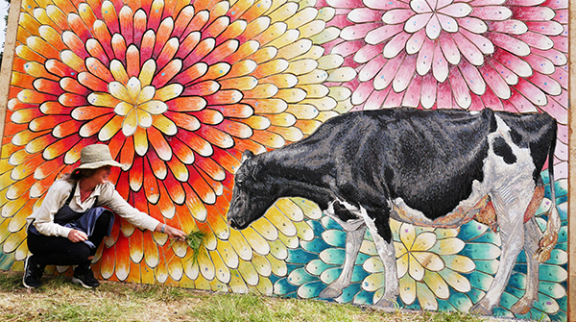
This is the artist's impression for the future Brunswick Junction Entry Statement. Have your say and let us know what you think.
Click here for more information
Notice is hereby given that the Restricted Burning Period (burning permit required) for the WHOLE of the Shire of Harvey has been extended until;
If you have any questions regarding this matter please contact the Administrator Law and Safety Services, 9729 0350 during normal working hours.
Click here for further information from the Department of Agriculture and Food
Check out our new online feature. Dogs that are in our safe custody at the Shire pound can now be viewed on this website. Click here to view the dogs currently impounded>
The new Building Act 2011 is effective from the 2nd April 2012. Click here to view the new forms, fees and guidelines.
Details of the tender and specifications of requirements are available by contacting Council’s Building Department at the Shire of Harvey on 9729 0330 during normal office hours or via Council’s webpage www.harvey.wa.gov.au.
| Mon | Tue | Wed | Thu | Fri | Sat | Sun |
|---|---|---|---|---|---|---|
| 30 | 1 | 2 | 3 | 4 | 5 | 6 |
| 7 | 8 | 9 | 10 | 11 | 12 | 13 |
| 14 | 15 | 16 | 17 | 18 | 19 | 20 |
| 21 | 22 | 23 | 24 | 25 | 26 | 27 |
| 28 | 29 | 30 | 31 | 1 | 2 | 3 |
On Stirling's first expedition to the Bunbury - Harvey area in 1830 he named it the Wellington District. He also gave names to physical features and sites in the district. These names came from prominent people of Britain.
At that time in 1830 the Prime Minister of Great Britain was Arthur Wellesley (the son of the Earl of Mornington). Wellesley had been given the title of Duke of Wellington in 1814 after leading his country in battle against the French and then defeated Napoleon at the Battle of Waterloo in 1815. Thomas Picton was a General under Wellington. King George IV reigning in 1830 was a descendant of the Duke of Brunswick-Luneburg. Brunswick River first appeared on a map in London in 1839.
The first farm in the Brunswick area was "Alverstoke". Development had commenced on this property by 1842 and Clifton's employees were growing wheat, barley and potatoes within the first few years. By 1844 John Ferguson was living at "Wedderburn". A year later in 1845 a bridge was built over the Brunswick River near the Australind Townsite to give the settlers in the Brunswick area easier access to Australind.
Soon afterwards more people settled near Clifton Road on the south side of Brunswick River and Melville Road on the north side.
At the time the railway opened in 1893, there were no people living in the present day townsite of Brunswick but many people by then had settled in the district.
The Brunswick Farmer's Association was formed in 1893 with David Eedle as the first Chairman. The Post Office operated north of the river crossing and the Old School House ("Frogmore") which served as a Church and a School was west of Brunswick on Clifton Road.
With the coming of the Railway Station more activity was bought into the area.
BRUNSWICK JUNCTION STATION
The Railway Bridge and Brunswick Siding were completed in 1893 with the first train coming through that same year. The siding was north of the river near a group of railway worker's cottages, not far from the Crampton home where the Post Office operated. When the line to Collie opened in 1898, Brunswick became a Junction south of the river. A railway station then was built south of the river, east of the present day Peter's Creameries.
(Shire of Harvey 1895-1995: Proud to be 100 p.52)