
Differential general rating is when a Council charges different rates depending on the type or use of the property.
This is done because different types of properties use services differently.
- Residential rates are raised to contribute towards ongoing maintenance and provision of works, services and facilities.
- Commercial/Industrial rates are raised to assist the funding of marketing, events and economic development related projects, activities and services.
The overall objective is to raise rate revenue in a manner that is simple, efficient and equitable to all ratepayers.
For each rateable property, Landgate provides a Gross Rental Value (GRV) or an Unimproved Value (UV).
- GRV is how much rent you would receive if you rented out your property.
- UV is the value of your land without any buildings that might be on it.
GRV is used for:
- Residential properties like houses and units
- Commercial properties like shops and offices
- Industrial properties like factories and processing plants
- Properties located in towns and built-up areas that are either vacant or established
UV is used for:
- Rural and farming land
- Commercial and Industrial properties that are outside of towns and built-up areas
These values are determined in line with State valuation. In other words, the state sets the rules, Landgate provides the values, and Council then uses those values to calculate rates.
Rates are calculated by multiplying the GRV or UV amount by the rate in the dollar set by the Shire of Harvey.
For example:
- General rate (GRV) $28,500 x 0.077971 = General rates $2,222.17
- General rate (UV) $550,000 x 0.004346 = General rates $2,390.30
Each year the Shire imposes a minimum payment per rate assessment. If the calculation of the GRV or UV by the rate in the dollar results in an amount less than the minimum charge, then the minimum charge will be applied.
For more information about guidance on property valuation, visit the Landgate website.
- A rating year is the same as the financial year, 1 July to 30 June.
- Rate notices can be issued any time after 1 July. However, the Shire of Harvey typically issue rates in August with a due date in September. It is recommended if you haven’t received your rates notice by the middle of September you query this with the Rates team.
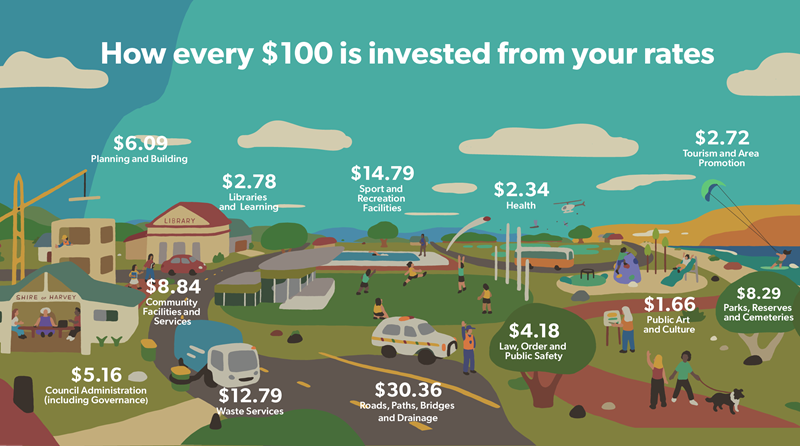
Rates are used to build and maintain roads, parks, gardens, beaches, recreation and sporting facilities and to operate other local community services. See the graphic below or the following dot points for a breakdown of how your rates are spent.
- Roads, Paths, Bridges and Drainage: $30.36
- Sport and Recreation Facilities: $14.79
- Waste Services: $12.79
- Community Facilities and Services: $8.84
- Parks, Reserves and Cemeteries: $8.29
- Planning and Building: $6.09
- Council Administration (including Governance): $5.16
- Law, Order and Public Safety: $4.18
- Libraries and Learning: $2.78
- Tourism and Area Promotion: $2.72
- Health: $2.34
- Public Art and Culture: $1.66
View the Shire’s Annual Budget for more information.
- The video below produced by WA Local Government Association explains the relationship between property prices and council rates.
- The Shire of Harvey understands it is sometimes easier to spread out larger bills by paying smaller more frequent payments. If you wish to make any payments towards your rates before they are raised, you are more than welcome. These payments will appear on your notice as a pre-payment.
You can obtain a balance by calling the Rates team on 9729 0310.
- It is possible for you to object to your property’s rate record in two circumstances:
- If you are not the owner of the property for which you have received a rate notice.
- You believe your property is non-rateable. For more information on non-rateable properties please refer to the Local Government Act 1995, section 6.26.
- You can appeal your rate notice by contacting the Shire on 9729 0310 within 42 days of your rate notice being issued.
- Objections to your property’s valuation should be directed to Landgate within 60 days of your rate notice being issued. Call 9273 7373 or visit Landgate.
- See the reverse of your rate notice for more information.
- Your account balance or credit will be handled by the settlement agency. They will instruct you on your required payments or how to obtain a refund.
- If there is a change which affects the amount of rates owing on a property, the owner will be issued with an interim rates notice. The most common reasons interim notices are issued is,
- A new property/subdivision
- A new house/building completed
- Waste/rubbish service charge
- Demolition of a building
- Additions/extensions to a home/building
- Understanding your interim rates brochure.
- Unfortunately, the rating database must match the certificate of title.
- If you have changed the ownership details with the title office, please advise the Shire immediately so we can correct our system.
For more information please contact us.
See also: